Introduction
Lichee-Jack is a low-cost, DIY social-engineering LAN Attack & Penetration Testing Army knife inspired by the Hak5 SharkJack. It is designed for payload delivery, opportunistic wired auditing, and red-team / SE engagements in environments where localnet is accessible.
Lichee-Jack combines USB gadget functionality, on-board Ethernet, and hardware mode selection into a compact, fully open-source platform.
100% open-source hardware & software Built for hackers, auditors, and embedded developers
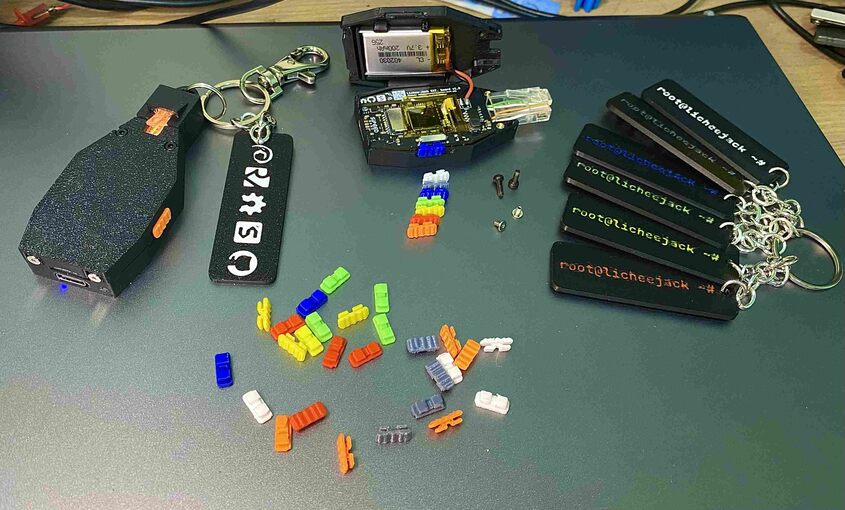
Features
- USB gadget functions
- Powered by gt (linux-usb-gadgets)
- CDC-ECM, RNDIS, HID, Mass-Storage (payload-dependent)
- 10/100 Mbps onboard Ethernet (GMAC)
- Sipeed LicheeRV Nano (SG2002 SoC, RISC-V)
- Open-source extension board
- 200 mAh Li-Po battery management (≈ 1+ hour uptime)
- NeoPixel RGB LED RJ45 status indicator
- SP3T mode-switch for payload / debug selection
- 2×10 1.27 mm header for extension modules
- Wi-Fi 6 + Bluetooth 5.2 (SDIO module)
- 1 W onboard speaker
- 16-bit digital microphone
- Micro-SD boot
- 3D-printable enclosures
How it works
Lichee-Jack is designed to operate as a plug-and-execute LAN implant with minimal user interaction.
1. Power & deployment
The device can be powered via:
- USB (host or charger)
- Internal Li-Po battery
Once powered, it boots directly from the SD card into a minimal Debian Linux environment.
2. Mode selection (hardware switch)
A physical SP3T mode-switch selects the operating mode before boot:
| Mode | Purpose |
|---|---|
| 0 | Debug / development mode |
| 1 | Payload 1 execution |
| 2 | Payload 2 execution |
The selected mode determines:
- Which payloads are executed
- Which USB gadget functions are exposed
- LED behavior and system services
3. Payload execution
Payloads are shell-based and executed automatically after boot.
Typical payload actions include:
- Network reconnaissance (ARP, DHCP, SNMP, mDNS)
- Traffic redirection or MITM setup
- Data exfiltration over USB or Ethernet
- LED / audio feedback for execution state
Payload logic is transparent and modifiable — no obfuscation, no closed binaries.
4. Visual & physical feedback
- RJ45 RGB LED
- Boot status
- Link state
- Payload activity
- Error conditions
- Optional audio cues via onboard speaker
This allows the operator to understand the device state without connecting a terminal.
5. Access & control
Depending on configuration, Lichee-Jack can expose:
- USB Ethernet (CDC-ECM / RNDIS)
- USB serial console
- SSH over USB or LAN
All services are controlled via init scripts and build-time configuration.
Contributors
Lichee-Jack is developed as a community-driven open-source project.
- KaliAssistant — Project author & maintainer
- Community contributors — hardware, firmware, payloads, documentation
Contributions are welcome:
- Payloads
- Hardware extensions
- Documentation improvements
- Bug fixes
See the repository for contribution guidelines.
Start using Lichee-Jack
Ready to get started?
- Flash the SD card image
- Select your mode with the hardware switch
- Plug it into a target network
- Let the payload run